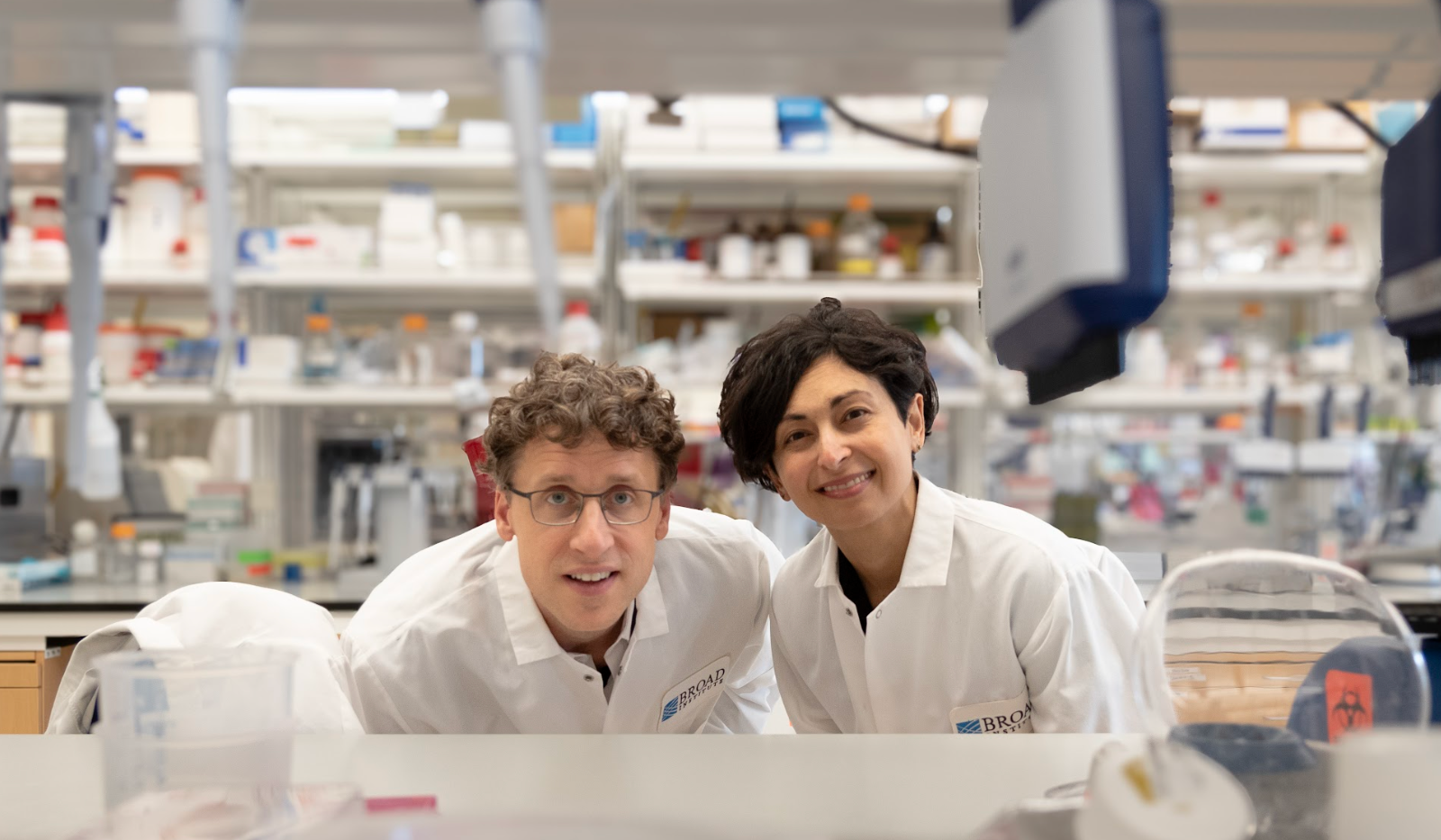
We are a biomedical research laboratory based at the Broad Institute. Founded by a wife-husband team motivated by a personal genetic diagnosis, our singular goal is to make prion disease a preventable and treatable condition, in our lifetime.
Clinical studies
- PRiSM (NN112), our clinical trial of divalent siRNA for prion disease, is now recruiting symptomatic prion disease patients and pre-symptomatic individuals at risk for genetic prion disease. See details: NCT07444580.
- OBSERVE (Biomarker Profiling in Individuals at Risk for Prion Disease), our observational study of individuals at genetic risk for prion disease, is now recruiting asymptomatic individuals with confirmed genetic variants or 50/50 risk. See details: NCT05124392
- PROSPECT (Registry for Individuals at Risk for Genetic Prion Disease), our long-term registry study of individuals at genetic risk for prion disease, is now recruiting asymptomatic individuals with confirmed genetic variants or genetic risk. See details: NCT07732608.
Open science & regulatory documents
We are committed to making drug development regulatory documents publicly available as a service to the rare disease community:
- Nov 14, 2017 Critical Path Innovation Meeting (CPIM) on CSF PrP as Accelerated Approval endpoint: white paper, meeting minutes.
- Oct 31, 2019 Type C meeting on CSF PrP as Accelerated Approval endpoint: meeting materials, CDER preliminary comments, Broad response, meeting minutes.
- Feb 5, 2025 INTERACT meeting on AAV PRNP-CHARM: meeting materials, CBER preliminary comments.
- Mar 14, 2025 PrP-lowering divalent siRNA IND 167326: full IND package on GitHub or Google Drive mirror.
- Jun 4, 2026 Pre-IND PS009720 for AAV PRNP-CHARM: meeting materials, preliminary responses, meeting summary.
- Oct 14, 2026 Opening of pre-symptomatic arm of divalent siRNA trial under IND 167326: complete response to clinical hold, response to information request, remove partial clinical hold letter, IRB-approved symptomatic ICF, pre-symptomatic ICF, trial protocol, and cover letter.
We are also committed to open, reproducible science. Each scientific paper we publish comes with a public GitHub repository, typically containing all of the raw data and source code needed to reproduce our analyses. Come see them all on our GitHub org.
The puzzle pieces to make prion disease developable
- Drug discovery and development. We have developed and advanced several drug candidates for prion disease. Our PrP-lowering drug portfolio includes oligonucleotides such as C16 siRNA, divalent siRNA and ASOs, for which we have done proof-of-concept as well as single-cell pharmacology; gene therapies including CRISPR base editors, the epigenetic editor CHARM and zinc finger repressors (ZF-KRAB); and a small molecule in collaboration with Gate Bioscience.
- Clinical trial readiness. We develop the tools and datasets needed to design and execute the best, most informative clinical trials in prion disease. Cerebrospinal fluid prion protein (CSF PrP) is our target engagement biomarker for PrP-lowering drugs, and we’ve evaluted its preanalytical sensitivity, developed ELISA and MRM assays to measure it, and discussed with FDA its suitability as an Accelerated Approval endpoint. Over both the short and long term, we have evaluated longitudinal stability of CSF PrP and the prognostic value of neurodegeneration and neuroinflammatory markers in at-risk individuals. We have suggested you shouldn’t always believe changes in neurofilament.
- Defining our genetic patient population. To prevent genetic prion disease, we need to know who is at risk, and when. We have quantified the lifetime risk and age of onset (evaluated both retrospectively and prospectively) associated with each PRNP variant, and shown that age of onset is constant over generations. We wrote the current genetic counseling guidance. We determined that VPSPr, a rare subtype of prion disease, is probably not genetic.
- Models and tools. We have developed humanized mouse models useful for screening drug candidates for PrP knockdown (available with a free, unrestrictive license). We have made the case why NHPs and mutant mouse models are not the right disease models for testing drugs.
- Disease mechanisms and biology. We have characterized the effects of heterozygous PRNP loss-of-function in humans and evaluated how PrP’s half-life impacts drug time-to-effect.
More about us
We also run a 501(c)(3) non-profit organization, Prion Alliance, through which you can donate to support our work. Eric blogs at CureFFI.org. Our story has been told in WIRED, The New York Times, Scientific American, NPR Morning Edition & All Things Considered, The Boston Globe, The Atlantic, The New Yorker, and Nature. We are affiliated with Broad’s Program in Brain Health, the MGH McCance Center for Brain Health, and the Department of Neurology at MGH.
 |
 |